Written for Six-Figure Brands, Read by Stores Doing Fifty Orders
Most Omnisend and Klaviyo comparisons are written for brands with six-figure email revenue. That framing misleads a store doing a few hundred orders a month.
At a modest list size, the decision hinges on different things. Setup speed, template quality, and the cost of switching later matter more than advanced predictive modelling.
This guide compares the two through the lens of a small Shopify store. It assumes a lean team, a list under roughly 10,000 contacts, and no dedicated email marketer.
The sections below cover pricing models, Shopify data depth, automation quality, and what it actually costs to leave.
One framing helps before the details. At small scale, email software is not a competitive advantage, so the winner is whichever tool gets solid flows live fastest without inflating your monthly bill.
Fast to Launch, or Deep and Demanding
- ● Omnisend - faster setup, SMS paid per message
- ● Klaviyo - deeper data, stronger segments
- ● Both - native Shopify sync
Pick Omnisend if you want prebuilt ecommerce flows that work on day one and a lower ceiling on complexity.
Pick Klaviyo if your growth plan depends on segmentation depth, granular browse and product data, and predictive metrics you will genuinely use.
Both connect natively to Shopify and pull orders, products, and customer records without custom work. Neither will hold your list hostage, though both make your flows painful to move.
For a store still finding its footing, Omnisend removes more friction. For a store with a clear repeat-purchase pattern, Klaviyo compounds faster.
Small Stores Usually Evaluate on the Wrong Criteria
Small stores tend to evaluate on the wrong criteria. Feature lists look similar, so the differences hide in how each platform bills and how deeply it reads your store.
How the platform counts what you pay for. Both charge by contact count, but sending limits attached to each tier differ. A list you email daily costs differently from one you email monthly.
How SMS is billed. SMS converts well for order updates and flash promotions. Expected text volume changes your true monthly spend, so price it alongside the email plan.
How much Shopify data flows in. Order history is table stakes. Browse events, cart events, product feeds, and back-in-stock triggers separate a basic sync from a deep one.
How good the starting templates are. A small team rarely has time to design flows from scratch. Strong defaults are worth more than a powerful blank canvas.
What leaving would cost. Contacts move easily. Flows, templates, and revenue history do not, which quietly locks you in after a year of building.
How the tool handles a list that grows unevenly. Seasonal stores collect contacts in bursts and then go quiet. A contact-based bill keeps charging for those dormant subscribers all year.
Whether deliverability tooling is included or extra. Both platforms handle sender reputation reasonably, but list hygiene features vary. Suppression rules and sunset flows protect your inbox placement more than any template choice.
What Each Platform Was Actually Built For
Omnisend was built specifically for ecommerce, with Shopify as its primary integration. Its plans include web push notifications, while SMS is sold separately as credits priced per message. Its prebuilt automation library covers cart abandonment, browse abandonment, welcome series, and post-purchase follow-ups without configuration.
Klaviyo is the deeper data platform of the two and the default choice for scaling Shopify brands. It stores richer customer profiles, supports granular behavioural segmentation, and includes predictive analytics such as expected date of next order. That depth carries a steeper learning curve. Its free plan includes $5 of mobile messages a month, so a small store can try SMS before paying.
Mailchimp remains a general-purpose email tool rather than an ecommerce specialist. Its Shopify integration works, but the store-data depth trails both options here. Our Mailchimp vs Constant Contact comparison covers where it still makes sense.
Brevo bills largely by emails sent rather than contacts stored, which suits large lists emailed infrequently. Its ecommerce automation is lighter than either specialist. The Constant Contact vs Brevo breakdown explains that pricing flip in detail.
MailerLite is the budget option for stores that mainly send newsletters and simple promotions. It handles clean campaigns well but offers shallower store data and fewer ecommerce triggers.
On Shopify data specifically, the two leaders diverge in a way that matters later rather than immediately. Omnisend pulls orders, products, carts, and browse activity, which covers the standard revenue flows a small store needs.
Klaviyo stores that same activity as richer event records tied to each profile. That structure lets you build conditions such as viewed a category twice but never purchased, which Omnisend approximates more loosely.
Both support back-in-stock alerts natively, which is a genuine advantage over general-purpose tools. Restock notifications often outperform promotional sends, so a store with frequent sellouts should weigh that feature heavily.
The Differences That Change a Small Store Decision
The table below focuses on what changes the answer for a small Shopify store.
| Feature | Omnisend | Klaviyo | Mailchimp | Brevo | MailerLite |
|---|---|---|---|---|---|
| Pricing model | Contacts, sends scale with tier | Contacts, with send limits per tier | Contacts, tiered by feature set | Mainly emails sent, not contacts | Contacts, simple tiers |
| Free entry tier | Yes, small cap | Yes, small cap | Yes, limited | Yes, daily send cap | Yes, limited |
| SMS billing | Credits added to any plan, paid per message | $5 a month included on free plan | Higher tiers or add-on | Separate credits | Not a core channel |
| Shopify sync depth | Deep, ecommerce-native | Deepest, event-rich | Moderate | Moderate | Basic |
| Browse and cart events | Yes | Yes, most granular | Partial | Partial | Limited |
| Back-in-stock alerts | Built in | Built in | Needs an app | Needs an app | Needs an app |
| Predictive analytics | Limited | Yes, core strength | Basic | Limited | No |
| Prebuilt ecommerce flows | Strong, ready to send | Strong, more configuration | Generic | Basic | Basic |
| Segmentation depth | Solid, mid-level | Very deep, condition-rich | Moderate | Moderate | Simple |
| Learning curve | Gentle | Steeper | Moderate | Moderate | Very gentle |
| Best for | Small stores wanting fast setup | Data-driven stores planning to scale | General small business email | Large, infrequently emailed lists | Newsletter-first stores |
Use the table to shortlist, then read the pricing and migration notes below.
Contact Count and Send Frequency Set Your Band
Start with your contact count and your sending frequency. Those two numbers set your cost band on either platform far more than any feature preference.
If you plan to send SMS at all, price it before deciding. Omnisend sells SMS credits on top of any plan, at $0.009 per US message in its $10 to $49.99 tier, as of October 2026. Klaviyo’s free plan includes $5 of mobile messages a month, so light texting can start there at no extra cost. Neither pricing page shows SMS bundled into a paid plan, so the SMS gap between them is small.
Next, judge your appetite for setup work. Omnisend’s flows tend to work acceptably out of the box, whereas Klaviyo rewards someone willing to tune conditions and segments.
Then look at your product catalogue. Stores with restocks, variants, and repeat purchase cycles get more from Klaviyo’s event depth than a store selling a handful of one-off items.
Consider who will maintain the account week to week. A founder splitting attention across fulfilment and ads will get more from strong defaults than from a flexible builder.
Automation quality is where that difference shows. Omnisend’s prebuilt flows arrive with copy, timing, and discount logic already arranged, so editing a few lines gets you live.
Klaviyo also ships flow templates, but its defaults assume you will customise triggers and filters. Left untouched, they underperform what the same effort produces on the simpler platform.
Finally, be realistic about your growth curve. If you expect to triple your list within a year, choose the platform you want at that size, not the one that is convenient today. The best email marketing software roundup covers the wider field if neither fits.
Common Mistakes to Avoid
Comparing only the entry price. Both platforms look inexpensive at a few hundred contacts. The cost curve steepens sharply once your list passes several thousand, and the gap between them changes shape.
Ignoring SMS in the budget. Teams often compare email plans, then add SMS later and find the total unrecognisable. Model both channels together from the start.
Buying segmentation depth you will never use. Klaviyo’s predictive metrics reward stores with enough order history to make predictions meaningful. A store with a few hundred orders has thin data to work from.
Assuming migration means exporting contacts. Contacts move in an afternoon. Flows, templates, segment definitions, and revenue attribution have to be rebuilt manually.
Letting the platform choice stall the store. A working welcome flow on the simpler tool beats a perfect flow that never launches. Ship something, then refine.
Skipping the platform layer underneath. If your store platform is still undecided, settle that first, since these integrations behave differently elsewhere. Our Shopify vs WooCommerce guide covers that decision.
Why the Bill Grows With Contacts You Never Email
Both tools price by contact count, and both raise the tier as your stored audience grows. Exact figures change often, so confirm current pricing on the official site.
The free tiers start in the same place. As of September 2026, Omnisend’s free plan covers 250 contacts and 500 monthly emails, and Klaviyo’s covers 250 profiles and 500 emails a month. Klaviyo’s free plan also includes $5 of mobile messages a month.
Omnisend layers send limits on top of its contact tiers, meaning your monthly email volume matters alongside list size. SMS is not part of the plan price, since you add SMS credits to any plan and pay per message. Review current tiers on the official Omnisend site before committing.
Klaviyo also scales by contacts and attaches a monthly send allowance to each tier. Its free plan includes $5 of mobile messages a month. For heavier texting, check current SMS pricing and tiers on the official Klaviyo site.
The practical method is simple. Take your real contact count, your monthly email volume, and your expected SMS sends, then price both platforms at those exact numbers.
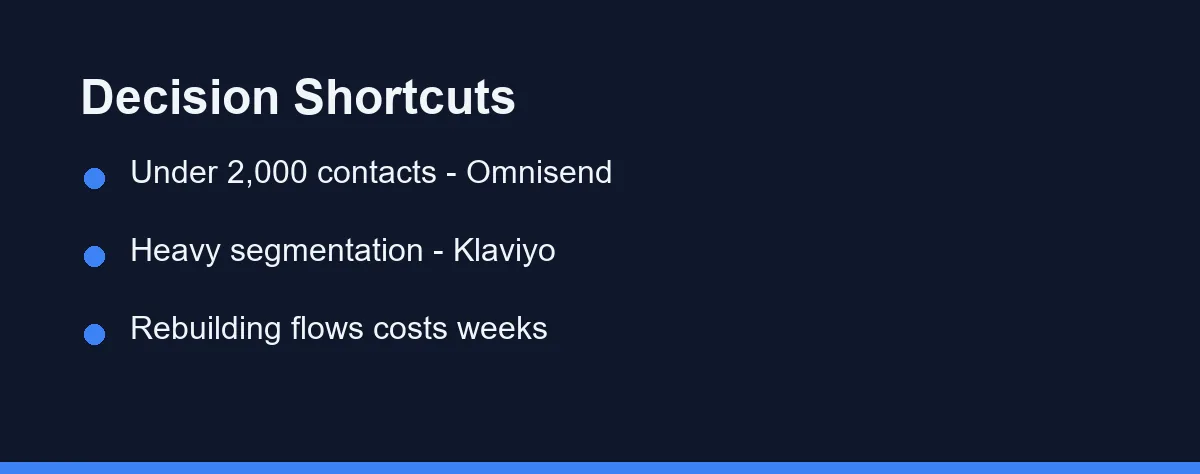
Also weigh the cost you cannot see on a pricing page. Rebuilding a mature flow library takes weeks of someone’s time, which usually dwarfs a monthly plan difference.
Migration deserves its own line in that estimate. Exporting contacts and re-importing them is quick, and both platforms accept a standard CSV with tags intact.
Everything else starts from zero. Flow logic, email templates, segment definitions, signup forms, and attributed revenue history all stay behind on the platform you leave.
That is why the choice matters more than it appears at signup. A store that picks well at 500 contacts avoids a disruptive rebuild at 5,000.
One habit reduces the risk either way. Keep a plain document describing each flow’s trigger, timing, and message, so a future rebuild is transcription rather than reinvention.
Verdicts by Use Case / Business Type
The table shortlists; this section decides. Here is the call for the store shapes that most often ask this question.
The store under 2,000 contacts with no dedicated marketer: Choose Omnisend. Its prebuilt flows arrive with copy, timing, and discount logic already arranged, so a founder can be live in an afternoon. At this size, flows that exist beat flows that are theoretically better.
The store that plans to send SMS alongside email: Treat SMS as a near tie and decide on the other factors. Omnisend adds per-message credits to any plan, at $0.009 per US text in its entry tier. Klaviyo’s free plan includes $5 of mobile messages a month, so you can trial SMS there before paying.
The store with restocks, variants, and repeat purchase cycles: Choose Klaviyo. Its event-rich profiles support conditions like viewed a category twice but never purchased, which Omnisend only approximates. Catalogue complexity, not revenue, is the signal here.
The seasonal store that collects contacts in bursts: Either works, but set a sunset policy before you sign. Contact-based pricing charges you all year for subscribers gathered in one busy quarter. Suppressing dormant contacts is the cheapest saving available on both platforms.
The store expecting to triple its list within a year: Choose Klaviyo now. Rebuilding a mature flow library takes weeks of someone’s time, which dwarfs any monthly plan difference you would save in the meantime. Pick the tool you want at your future size, not your current one.
Same Problem, Two Different Store Stages
Omnisend and Klaviyo solve the same problem for stores at different stages. Omnisend optimises for a small team that wants revenue-generating flows running quickly, with little setup.
Klaviyo optimises for depth. It rewards stores with enough order history and catalogue complexity to justify granular segmentation and predictive metrics.
For a modest Shopify list, the honest default is Omnisend, with Klaviyo as the deliberate upgrade once data volume justifies it. Switching later is possible but never free, so weigh the rebuild cost now.
Confirm current plans and integration details on both official sites before committing.
The email tool is the second decision, because it plugs into whatever storefront you already run. If that platform is still undecided, Shopify vs Squarespace for a small online store walks through what each one was built to do first.
Some stores do not need either app yet, because Shopify already includes 10,000 free emails a month. If your list is still in the low thousands, check whether Shopify Email is enough for a small store before adding a second monthly bill.
FAQ
Is Omnisend cheaper than Klaviyo for a small store?
Not because of SMS. Omnisend does not bundle SMS into its plans, so you add SMS credits and pay per message, at $0.009 per US text in its $10 to $49.99 tier. Klaviyo's free plan includes $5 of mobile messages a month. The real gap comes from contact tiers and send limits, so price both at your real contact count and expected text volume.
Does Klaviyo work with Shopify for free?
Klaviyo offers a free entry tier with a low contact and send cap, and its Shopify app installs without a paid plan. The free tier still syncs orders and products, so you can build a welcome and abandoned-cart flow before paying. You outgrow it quickly once your list passes a few thousand contacts.
Can you migrate automation flows from Klaviyo to Omnisend?
Not automatically. Contacts, tags, and segments export and import cleanly through CSV, but automation flows, templates, and historical revenue attribution do not transfer between the two platforms. Plan to rebuild every flow by hand, which is the real reason switching later feels expensive.
Do Omnisend and Klaviyo both integrate natively with Shopify?
Both connect to Shopify through a native app that syncs orders, products, and customer records without custom development. Klaviyo stores that activity as richer event data tied to each profile, which supports more granular conditions later. For standard revenue flows like cart abandonment and post-purchase, either sync is sufficient on day one.
Are Klaviyo's predictive analytics useful for a store with few orders?
Klaviyo's predictive metrics, such as expected date of next order, need enough order history to produce meaningful estimates. A store with a few hundred orders and a short trading history has thin data behind those predictions. Treat them as a reason to choose Klaviyo later rather than a reason to choose it now.
Sources
- Omnisend: Pricing — checked 2026-10-01
- Klaviyo: Pricing — checked 2026-10-01
Some links may be affiliate links. We may earn a commission at no extra cost to you.
How this article was made: it was drafted with AI assistance from the official sources listed above, and its figures were checked against those pages on the dates shown. It is not based on personal hands-on testing.
Comments
Post a Comment